

On this page
Nine digits, and no 0 to drop
UK, French and German numbers have a leading 0 that disappears after the country code. Spanish numbers don’t: the plan has no national prefix. Add a 0 out of habit and you break the number, because Spain keeps the 0 for short public-service codes and the 00 international prefix. 091 alone is the National Police.
| What you see | What to type | In FaxTonic |
|---|---|---|
| 91 123 45 67 | As written | Accepted |
| +34 91 123 45 67 | As written | Accepted; the + selects Spain for you |
| +34 (0)91 123 45 67 | +34 91 123 45 67 | Refused with the (0) |
| 091 123 45 67 | 91 123 45 67 | Refused with the 0 |
| 011 34 91 123 45 67 | 91 123 45 67 | Refused with Spain selected |
Reading the first digits
Unlike a US number, a Spanish number shows its type. A regular number tied to a province starts with 9 or 8, and its second digit is never 0. A second digit of 0 marks a special-tariff number, and of those, FaxTonic accepts only 800 and 900.
| Starts with | What it is | In FaxTonic |
|---|---|---|
| 9 or 8, then not 0 | Geographic: 91 is Madrid, 93 is Barcelona | Accepted |
| 6, or 71 to 74 | Mobile, your cell number | Refused |
| 70, 901, 902 | Personal, shared-cost and caller-pays numbers | Refused |
| 803, 806, 807, 905 | Premium rate, including TV votes | Refused |
| 400 | Sales lines that only call out. Calling one is prohibited | Refused |
| 800, 900 | Freephone for callers in Spain. Your fax still costs the page price | Accepted, but delivery can’t be promised |
The 902 on the letterhead
A 902 number can pass for a company’s main line. Spain’s 2021 numbering guide says companies and other organizations use 901 and 902 widely, and that such “smart numbers” can redirect calls to ordinary lines. So a 902 tells you nothing about a fax line, and FaxTonic refuses it.
Ask the recipient for the fax line’s own number: nine digits with a province code.
An older 902 may also be out of date: an April 2026 Spanish resolution limits customer-service lines at companies under the 2025 customer-service law to 800, 900, geographic and short numbers, with an exception for smaller energy and phone retailers.
A burofax isn’t a fax
If someone in Spain asks for a burofax, a fax isn’t what they asked for, despite the name. A burofax is a service of Correos, Spain’s postal operator, which prints your document and delivers it by hand against a signature. Correos says this lets you show what you sent, when, and who received it. It can also certify the exact content, which its burofax page lists as an additional service.
A FaxTonic fax does none of that. The status page only records that the receiving machine confirmed the fax, and we don’t issue a transmission report. For a burofax, go to Correos. It says Mi Oficina, its online service, works from anywhere, but check that it suits you from the US.
One country code, two clocks
The Balearic Islands, the Canary Islands, Ceuta and Melilla all use +34, at the same price as Madrid. The first digits show where a fax is going:
- Balearic Islands: 971 or 871.
- Canary Islands: 922, 822, 928 or 828.
- Ceuta: 956, shared with Cádiz. Melilla: 952, shared with Málaga.
Andorra (+376) and Gibraltar (+350) have their own country codes, and FaxTonic doesn’t send to either.
Spain also has two official times: the Canary Islands stay one hour behind the mainland and the Balearics. The mainland is 6 hours ahead of US Eastern time and 9 ahead of Pacific; the Canaries are 5 and 8 ahead. That matters if you call an office in Las Palmas to confirm a number.
Each gap shrinks by an hour for a few weeks a year: Spain changes its clocks on the last Sundays of March and October, the US on the second Sunday of March and the first Sunday of November.
What a page costs, and a cover in Spanish
A page to Spain costs $2.69, more than our other destinations, because Spanish landlines cost more to reach. Time of day and call length don’t change it, and the cover page is free.
Send from the Spanish app and the cover prints in Spanish, with prices in euros, not dollars.
FaxTonic only sends, so nobody in Spain can fax a reply to the US number in each page’s header. If you want an answer, give an email address, phone number or mailing address.
How to fax Spain with FaxTonic
- Get your document ready as PDF, JPEG, and PNG, up to 20 pages with the cover. An A4 page shrinks slightly to fit US Letter.
- Open FaxTonic, or the Spanish app for a Spanish cover. Add your file and put your name on the cover.
- Choose Spain and type the nine digits, with no 0, 011 or extension.
- At the review step, compare the +34 number with your source, digit by digit. Then look over the total and pay by card.
- Follow the status page: sending, then delivered or failed. If it fails, the “What to check” box gives the reason when the carrier supplied one.
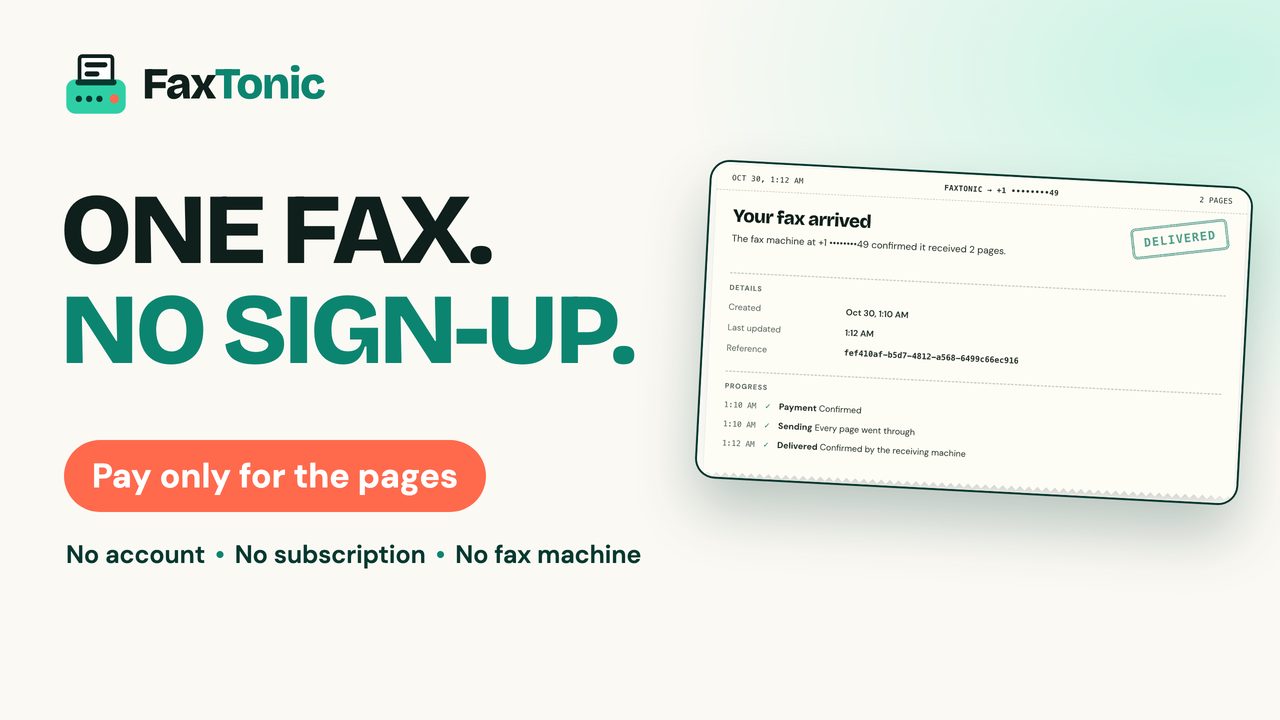
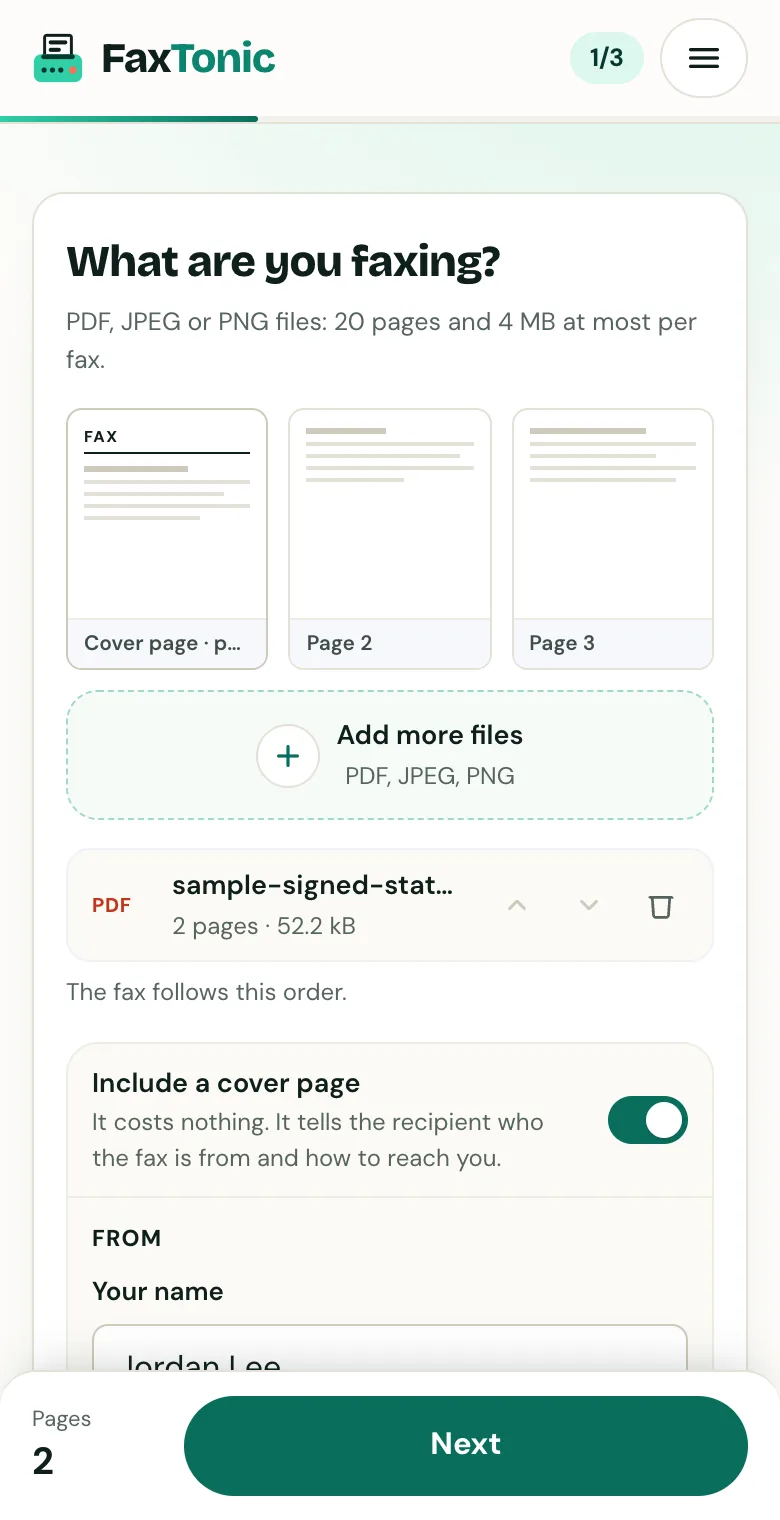
Add your file. The cover page is free, and you can turn it off.
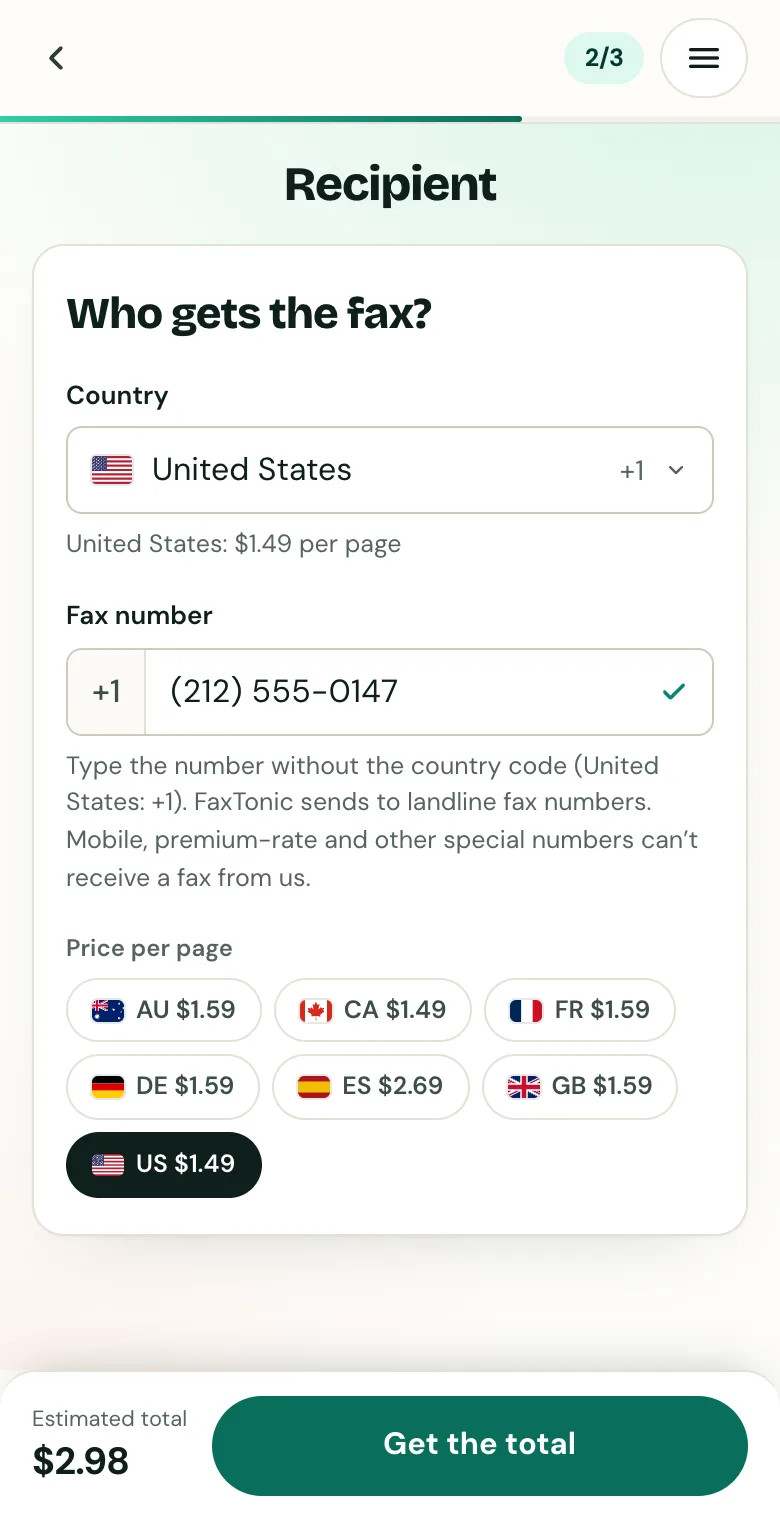
Pick the country and type the fax number.
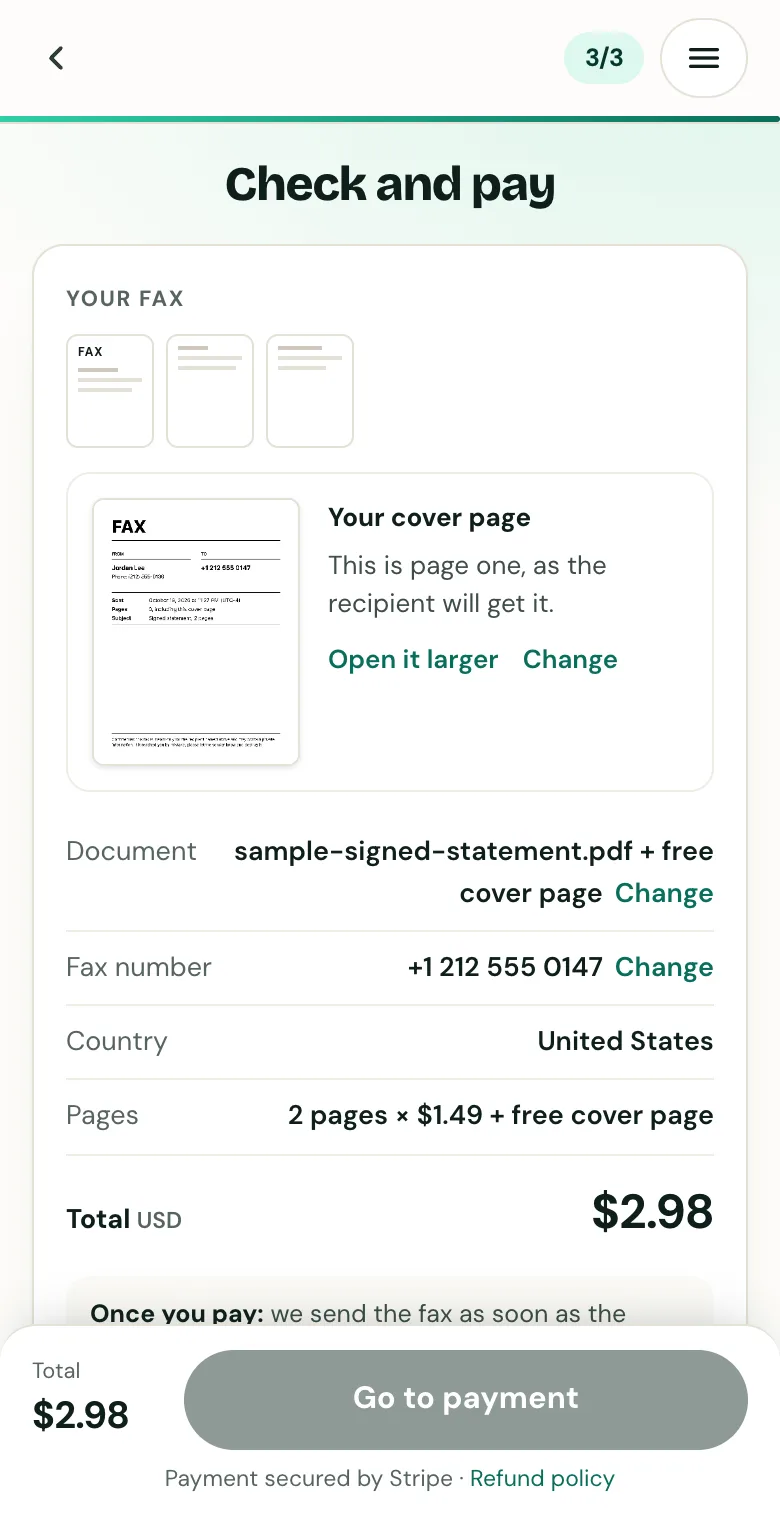
Check the cover page, the number and the total before you pay.
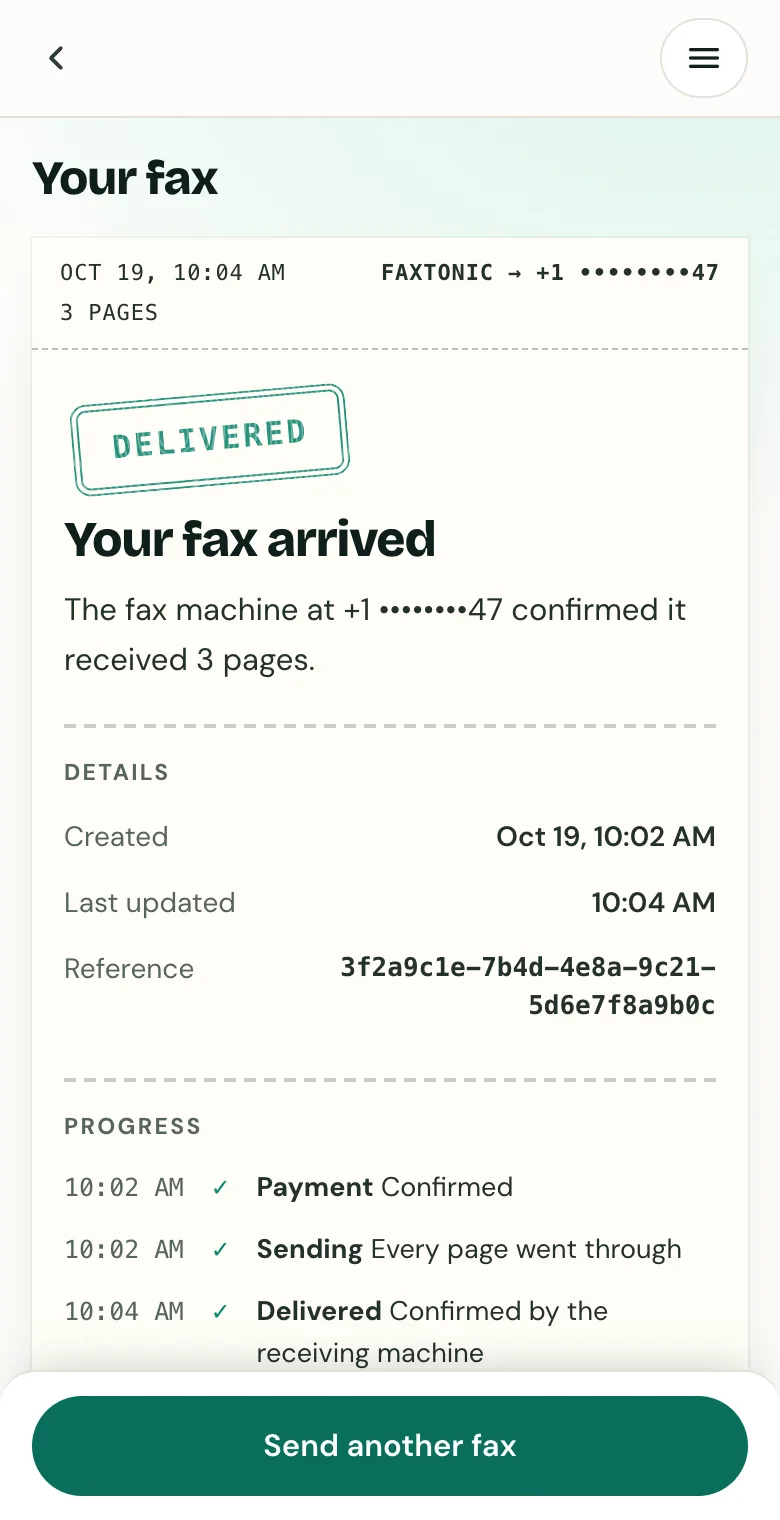
Track your fax: the status page shows when it’s delivered.
A fax that can’t be delivered is refunded automatically. We hold back a fee of $0.30 + 2.9% and return the rest, or we return everything if our fax provider refused the fax when we submitted it. A delivered fax isn’t refunded, even to a wrong number. See the refund policy.
Official sources
- Spanish Ministry for Digital Transformation: description of the national numbering plan, 2016 (PDF)
- Spanish Ministry for Digital Transformation: national numbering plan user guide, 2021 (PDF)
- Spanish Ministry for Digital Transformation: E.164 numbering plan for code 34 (PDF)
- BOE: Real Decreto 2296/2004, which approves Spain’s numbering plan (consolidated PDF)
- BOE: Resolution of April 14, 2026, on numbers for customer-service lines
- BOE: Resolution of April 14, 2026, on the 400 range for sales calls
- BOE: Resolution of April 27, 2026, on geographic 8XY codes
- BOE: Ley 10/2025 on customer-service departments (consolidated PDF)
- Correos: what a burofax is and how it works (2026)
- Correos: Premium Burofax for private customers
- BOE: 2025 order on election mail, which describes Correos as Spain’s universal postal service provider
- Spanish government delegation in Ceuta: directory
- Autonomous City of Melilla: contact page
- ITU: dialling procedures by country, Operational Bulletin 994 (PDF)
- ITU: list of E.164 country codes, Operational Bulletin 1114 (PDF)
- BOE: Real Decreto 236/2002 on summer time, with Spain’s two official times
- AEMET, Spain’s weather agency: official time on the mainland and in the Canary Islands
- European Commission: summer-time calendar for 2027 to 2031, published in the BOE
- NIST: daylight saving time rules in the US
- US Code: 15 U.S.C. 261, zones for standard time
- US Code: 15 U.S.C. 263, names of the zones
FaxTonic is an independent fax service. It isn’t affiliated with or endorsed by any agency, insurer, court or company named in this guide. Fax numbers and rules change: when a letter or form gives you a fax number, use that one.